|
WHO WAS ABRAHAM?
An article by Gene D. Matlock
In his History of the Jews, the Jewish scholar and theologian Flavius
Josephus
(37 - 100 A.D.), wrote that the Greek philosopher Aristotle had said: "...These
Jews are derived from the Indian philosophers; they are named by the Indians
Calani." (Book I:22.)
Clearchus of Soli wrote, "The Jews descend from the philosophers of
India. The philosophers are called in India Calanians and in Syria Jews.
The name of their capital is very difficult to pronounce. It is called
'Jerusalem.'"
"Megasthenes, who was sent to India by Seleucus
Nicator, about three
hundred years before Christ, and whose accounts from new inquiries are every day
acquiring additional credit, says that the Jews 'were an Indian tribe or sect
called Kalani...'" (Anacalypsis, by Godfrey Higgins, Vol. I; p. 400.)
Martin Haug, Ph.D., wrote in The Sacred Language, Writings, and Religions
of the Parsis, "The Magi are said to have called their religion
Kesh-î-Ibrahim.They traced their religious books to Abraham, who was believed
to have brought them from heaven." (p. 16.)
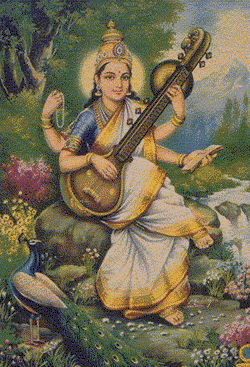
There are certain striking similarities between the Hindu god
Brahma
and his consort Saraisvati, and the Jewish Abraham and Sarai,
that are more than mere coincidences. Although in all of India there is only one
temple dedicated to Brahma, this cult is the third largest Hindu sect.
In his book Moisés y los Extraterrestres, Mexican author Tomás
Doreste states,
Voltaire was of the opinion that Abraham descended from
some of the numerous Brahman priests who left India to spread their
teachings throughout the world; and in support of his thesis he presented
the following elements: the similarity of names and the fact that the city
of Ur, land of the patriarchs, was near the border of Persia, the road to
India, where that Brahman had been born.
The name of Brahma was highly respected in India, and his
influence spread throughout Persia as far as the lands bathed by the rivers
Euphrates and Tigris. The Persians adopted Brahma and made him their own.
Later they would say that the God arrived from Bactria, a mountainous region
situated midway on the road to India. (pp. 46-47.)
Bactria (a region of ancient Afghanistan) was the locality
of a prototypical Jewish nation called Juhuda or Jaguda, also called Ur-Jaguda.
Ur meant "place or town." Therefore, the bible was correct in
stating that Abraham came from "Ur of the Chaldeans."
"Chaldean," more correctly Kaul-Deva (Holy Kauls), was not the
name of a specific ethnicity but the title of an ancient Hindu Brahmanical
priestly caste who lived in what are now Afghanistan, Pakistan, and the
Indian state of Kashmir.
"The tribe of Ioud or the Brahmin Abraham, was
expelled from or left the Maturea of the kingdom of Oude in India and,
settling in Goshen, or the house of the Sun or Heliopolis in Egypt, gave it
the name of the place which they had left in India, Maturea." (Anacalypsis;
Vol. I, p. 405.)
"He was of the religion or sect of Persia, and of
Melchizedek."(Vol. I, p. 364.)
"The Persians also claim Ibrahim, i.e. Abraham, for
their founder, as well as the Jews. Thus we see that according to all
ancient history the Persians, the Jews, and the Arabians are descendants of
Abraham.(p.85) ...We are told that Terah, the father of Abraham, originally
came from an Eastern country called Ur, of the Chaldees or Culdees, to dwell
in a district called Mesopotamia. Some time after he had dwelt there,
Abraham, or Abram, or Brahma, and his wife Sara or Sarai, or Sara-iswati,
left their father's family and came into Canaan. The identity of Abraham and
Sara with Brahma and Saraiswati was first pointed out by the Jesuit
missionaries."(Vol. I; p. 387.)
In Hindu mythology,
Sarai-Svati is Brahm's sister. The bible gives two stories of Abraham. In this
first version, Abraham told Pharaoh that he was lying when he introduced Sarai
as his sister. In the second version, he also told the king of Gerar that Sarai
was really his sister. However, when the king scolded him for lying, Abraham
said that Sarai was in reality both his wife and his sister! "...and yet
indeed she is my sister; she is the daughter of my father, but not the daughter
of my mother; and she became my wife." (Genesis 20:12.)
But the anomalies don't end here. In India, a tributary of the river
Saraisvati is Ghaggar. Another tributary of the same river is Hakra. According
to Jewish traditions, Hagar was Sarai's maidservant; the Moslems say she was an
Egyptian princess. Notice the similarities of Ghaggar, Hakra and Hagar.
The bible also states that Ishmael, son of Hagar, and his descendants lived
in India. "...Ishmael breathed his last and died, and was gathered to
his kin... They dwelt from Havilah (India), by Shur, which is close to Egypt,
all the way to Asshur." (Genesis 25:17-18.) It is an interesting fact
that the names of Isaac and Ishmael are derive from Sanskrit: (Hebrew) Ishaak
= (Sanskrit) Ishakhu = "Friend of Shiva." (Hebrew) Ishmael
= (Sanskrit) Ish-Mahal = "Great Shiva."
A third mini-version of the Abraham story turns him into another
"Noah." We know that a flood drove Abraham out of India. "...Thus
saith the Lord God of Israel, your fathers dwelt on the other side of the flood
in old time, Even Terah, the father of Abraham, and the father of Nachor; and
they served other gods. And I took your father Abraham from the other side of
the flood, and led him throughout all the land of Canaan." (Joshua
24:2-3.)
Genesis 25 mentions some descendants of his concubine Ketura (Note: The
Moslems claim that Ketura is another name of Hagar.): Jokshan; Sheba; Dedan;
Epher. Some descendants of Noah were Joktan, Sheba, Dedan, and Ophir. These
varying versions have caused me to suspect that the writers of the bible were
trying to unite several different branches of Judaism.
About 1900 BC, the cult of Brahm was carried to the Middle and Near East by
several different Indian groups after a severe rainfall and earthquake tore
Northern India apart, even changing the courses of the Indus and Saraisvati
rivers. The classical geographer Strabo tells us just how nearly complete the
abandonment of Northwestern India was. "Aristobolus says that when he
was sent upon a certain mission in India, he saw a country of more than a
thousand cities, together with villages, that had been deserted because the
Indus had abandoned its proper bed." (Strabo's Geography, XV.I.19.)
"The drying up of the Sarasvati around 1900 BCE, which led to a major
relocation of the population centered around in the Sindhu and the Sarasvati
valleys, could have been the event that caused a migration westward from India.
It is soon after this time that the Indic element begins to appear all over West
Asia, Egypt, and Greece." (Indic Ideas in the Graeco-Roman World,
by Subhash Kak, taken from IndiaStar online literary magazine; p.14)
Indian historian Kuttikhat Purushothama Chon believes that Abraham was driven
out of India. He states that the Aryans, unable to defeat the Asuras (The
mercantile caste that once ruled in the Indus Valley or Harappans) spent so many
years fighting covertly against the Asuras, such as destroying their huge system
of irrigation lakes, causing destructive flooding, that Abraham and his kindred
just gave up and marched to West Asia. (See Remedy the Frauds in Hinduism.)
Therefore, besides being driven out of Northern India by floods, the Aryans also
forced Indian merchants, artisans, and educated classes to flee to West Asia.
Edward Pococke writes in India in Greece,
"...in no similar instance have events occurred fraught with
consequences of such magnitude, as those flowing from the great religious
war which, for a long series of years, raged throughout the length and
breadth of India. That contest ended by the expulsion of vast bodies of men;
many of them skilled in the arts of early civilization, and still greater
numbers, warriors by profession. Driven beyond the Himalayan mountains in
the north, and to Ceylon, their last stronghold in the south, swept across
the Valley of the Indus on the west, this persecuted people carried with
them the germs of the European arts and sciences. The mighty human tide that
passed the barrier of the Punjab, rolled on towards its destined channel in
Europe and in Asia, to fulfill its beneficent office in the moral
fertilization of the world.the distance of the migratory movement was so
vast, the disguise of names so complete, and Grecian information so
calculated to mislead, that nothing short of a total disregard of theoretic
principles, and the resolution of independent research, gave the slightest
chance of a successful elucidation."
(p. 28.)
If all these
refugee ruling peoples were exclusively of Indian heritage,
why doesn't History mention them?
The exodus of refugees out of ancient India did not occur all at once but
over a period of one or more thousand years. If all these refugee ruling peoples
were exclusively of Indian heritage, why doesn't History mention them? Indeed
they are mentioned as Kassites, Hittites, Syrians, Assyrians, Hurrians, Arameans,
Hyksos, Mittanians, Amalekites, Aethiops (Atha-Yop), Phoenicians, Chaldeans, and
many others. But we have been wrongly taught to regard them as ethnicities
indigenous to Western Asia. Our history books also call them "Indo-Europeans,"
causing us to wonder where they were really from. "The people of India
came to realize their social identity in terms of Varna and Jati (societal
functions or caste); not in terms of races and tribes." (Foundations of
Indian Culture; p. 8.)
Here's an example of how the ancient Indians identified people: The leaders
were called Khassis (Kassites), Kushi (Kushites), Cossacks (Russian military
caste) Caesars (Roman ruling caste), Hattiya (Hittites), Cuthites (a dialectical
form of Hittite), Hurrite (another dialectical form of Hittite), Cathay (Chinese
leaders), Kasheetl/Kashikeh among the Aztecs, Kashikhel/Kisheh by the Mayans,
and Keshuah/Kush by the Incas. The Assyrians (in English), Asirios (in Spanish),
Asuras or Ashuras (India), Ashuriya, Asuriya (Sumer and Babylonia), Asir
(Arabia), Ahura (Persia), Suré in Central Mexico, etc., were people who
worshipped Surya (the Sun).
Naturally, in areas where this religion prevailed, they were known as
"Assyrians," no matter what the real names of their respective
kingdoms were.
Another problem that western scholars have in identifying the Indo-Europeans
as Indians is that India was not then and never was a nation.
Furthermore, it is not "India." It is Bharata, and even Bharata
is not a nation. Bharata is a collection of nations, just as Europe is a
collection of nations, presently held together by the real or perceived threat
of Moslem expansionism. Indian scholars have told me that when and if this
expansionism ever disappears, the "Bharata Union" will again splinter
into many smaller nations.
"The Arabian historians contend that Brahma and Abraham, their
ancestor, are the same person. The Persians generally called Abraham Ibrahim
Zeradust. Cyrus considered the religion of the Jews the same as his own. The
Hindoos must have come from Abraham, or the Israelites from Brahma..." (Anacalypsis; Vol. I, p. 396.)
Was our
Abraham Really the Hindu Deity Ram?
Ram and Abraham were possibly the same person or clan. For example, the
syllable "Ab" or "Ap" means "father" in Kashmiri.
The prototypical Jews could have called Ram "Ab-Ram" or "Father
Ram." It's also conceivable that the word "Brahm" evolved from
"Ab-Ram" and not vice-versa. The Kashmiri word for "Divine
Mercy," Raham, likewise derives from Ram. Ab-Raham = "Father of Divine
Mercy." Rakham = "Divine Mercy" in Hebrew; Ram is also the Hebrew
term for "highly placed leader or governor." Indian historian A. D.
Pusalker, whose essay "Traditional History From the Earliest Times"
appeared in The Vedic Age, said that Ram was alive in 1950 BC, which is
about the time that Abraham, the Indo-Hebrews, and the Aryans made the greatest
India-to-the-Middle East migration since the Great Flood.
"One of the shrines in the Kaaba was also dedicated to the Hindu
Creator God, Brahma, which is why the illiterate prophet of Islam claimed it
was dedicated to Abraham. The word "Abraham" is none other than a
malpronunciation of the word Brahma. This can be clearly proven if one
investigates the root meanings of both words. Abraham is said to be one of
the oldest Semitic prophets. His name is supposed to be derived from the two
Semitic words 'Ab' meaning 'Father' and 'Raam/Raham' meaning 'of the
exalted.' In the book of Genesis, Abraham simply means 'Multitude.' The word
Abraham is derived from the Sanskrit word Brahma. The root of Brahma is 'Brah'
which means - 'to grow or multiply in number.' In addition Lord Brahma, the
Creator God of Hinduism is said to be the Father of all Men and Exalted of
all the Gods, for it is from him that all beings were generated. Thus again
we come to the meaning 'Exalted Father.' This is a clear pointer that
Abraham is none other than the heavenly father Brahma."
(Vedic Past of Pre-Islamic Arabia; Part VI; p.2.)
Several word-meanings can be extracted from "Abram," each of which
points directly to his exalted position. Ab = "Father;" Hir or H'r =
"Head; Top; Exalted;" Am = "People." Therefore, Abhiram or
Abh'ram can mean "Father of the Exalted." Here's still another: Ab -
î - Ram = "Father of the Merciful." Ab, also meaning
"Snake," could indicate that Ab-Ram (Exalted Snake) was a Naga king.
All the meanings that can be extracted from the compound word
"Abraham" reveal the divine destiny of his followers. Hiram of Tyre,
Solomon's close friend, was "Exalted People" or Ahi-Ram (Exalted
Snake).
In ancient India, the Aryan cult was called "Brahm-Aryan." The
Aryans worshiped multiple gods. Abraham turned away from polytheism. By so
doing, he could have become "A-Brahm" (No longer a Brahman.) The
Aryans called the Asuras "Ah-Brahm." Therefore, we can logically
assume that the fathers of the Indus civilization were probably prototypical
Jews.
Jerusalem was a Hittite (Indian hereditary leadership caste) city at the time
of Abraham's death. In Genesis 23:4, Abraham asked the Jerusalem Hittites to
sell him a burial plot. The Hittites answered, "...thou art a prince
among us: in the choice of our sepulchres bury thy dead; none of us shall
withhold from thee." (p. 6). If Abraham was revered as a prince by the
Hittites, he, too, was a highly regarded member of India's hereditary ruling and
warrior caste. The bible never did say that Abraham wasn't a Hittite. It just
said, "I am a stranger and a sojourner with you." (Genesis
23:4.) As the Hittites said, they recognized Abraham as being even above them.
Just as the Hittites were not a unique ethnicity, neither were the Amorites or
Amarru. Marruta was the Indian caste name of commoners. The word
"Amorite" (Marut) was the first caste name of the Indian Vaishyas:
craftsmen, farmers, cattlemen, traders, etc.
G. D. Pande writes in Ancient Geography of Ayodhya,
"Maruts
represented the Visah. The Maruts are described as forming troops or masses.
Rudra, the father of the Maruts, is the lord of cattle." (p. 177.)
Malita J. Shendge states: "...the Maruts are the people." (The
Civilized Demons; p. 314.) We should not be surprised to find the Khatti
(Hittites) and Maruts (Amorites) functioning as the fathers (protectors) and
mothers (helpmates or assistants) of Jerusalem.
In India, the Hittites were also known as Cedis or Chedis (pronounced Hatti
or Khetti). Indian historians classify them as one of the oldest castes of the
Yadavas. "The Cedis formed one of the most ancient tribes among the
Ksatriyas (the aristocratic class made up of Hittites and Kassites) in early
Vedic times. As early as the period of the Rgveda the Cedi kings had acquired
great reknown... they are one of the leading powers in northern India in the
great epic." (Yadavas Through the Ages, p. 90.) Ram or Rama also
belonged to the Yadava clan. If our Abraham, Brahm, and Ram are the one and the
same person, Abraham went to Jerusalem to be with his own people!
Ram's congregations segregated themselves in their own communities, called
Ayodhya, which in Sanskrit means "The Unconquerable." The Sanskrit
word for "fighter" is Yuddha or Yudh. Abraham and his group belonged
to the Ayodhya (Yehudiya, Judea) congregation who remained aloof from
non-believers and Amalekites (Aryans?).
Melchizadek...
the sage of Salem
If what I have said thus far isn't convincing enough, maybe the word
"Melchizedek" will be. Melchizedek was a king of Jerusalem who
possessed secret mystical and magical powers. He was also Abraham's teacher.
Melik-Sadaksina was a great Indian prince, magician, and spiritual giant -
the son of a Kassite king. In Kashmiri and Sanskrit, Sadak = "a person with
magical, supernatural powers." A certain Zadok (Sadak?) was also a
supernaturally-endowed priest who annointed Solomon. Why does the Kassite (of
royal caste) Melik-Sadaksina, a mythical Indian personage, suddenly appear in
Jerusalem as the friend and mentor of Abraham? According to Akshoy Kumar
Mazumdar in The Hindu History, Brahm was the spiritual leader of the
Aryans. As an Aryan (Not of Yah), he naturally believed in idols. The bible says
that he even manufactured them. Upon seeing how increasing idol worship and
religious guesswork were contributing to the further downfall of his people,
Brahm backed away from Aryanism and reembraced the ancient Indian (Yah)
philosophy (Cult of the MaterialUniverse) even though it, too, was foundering in
manmade evils. He decided that mankind could save himself only by dealing with
what was real; not the imagined.
Shocked at the barbarism and blind selfishness of the people, the wise men
and educated people among the proto-Hebrews isolated themselves from the masses.
Dr. Mazumdar wrote, "The moral fall was rapid. The seers and sages lived
apart from the masses. They seldom married and were mostly given to religious
contemplation. The masses, without proper light and leader, soon became vicious
in the extreme. Rape, adultery, theft, etc., became quite common. Human nature
ran wild. Brahma (Abraham) decided to reform and regenerate the people. He made
the chief sages and seers to marry and mix with the people. Most refused to
marry, but 30 agreed." Brahm married his half sister Saraisvati. These
sages became known as prajapatis (progenitors).
"Northern Afghanistan was called Uttara Kuru and was a great center of
learning. An Indian woman went there to study and received the title of Vak,
i.e. Saraisvati (Lady Sarah). It is believed that Brahm, her teacher (and half
brother), was so impressed by her beauty, education, and powerful intellect,
that he married her." (The Hindu History; p. 48, in passim.)
From the holy community in Southern Afghanistan, similar communities spread
all over the world: the whole of India, Nepal, Thailand, China, Egypt, Syria,
Italy, the Philippines, Turkey, Persia, Greece, Laos, Iraq, - even the Americas!
The linguistic evidence of Brahm's presence in various parts of the world is
more than evident: Persian: Braghman (Holy); Latin: Bragmani (Holy); Russian:
Rachmany (Holy); Ukranian Rachmanya (Priest; Holy); Hebrew: Ram (Supreme
Leader); Norwegian From (Godly). A sacred word among the Hindus was and is the
mystic syllable OM. It is associated eternally with the earth, sky, and heaven,
the Triple Universe. It is also a name of Brahm. The Aztecs also worshiped and
chanted the syllable OM as the dual principal of all creation: OMeticuhlti (Male
Principle) and OMelcihuatl (Female Principle). The Mayan priestly caste was
called Balam (pronounced B'lahm). Had an "R" sound existed in Mayan,
it would have been Brahm. The Peruvian Incas worshiped the sun as Inti Raymi
(Hindu Ram).
Names that undeniably derive from Rama literally pepper Native-American
languages, especially the languages of those tribes extending from our American
Southwest, to Mexico, and all the way to South America, beyond Peru. The
Tarahumara Indians of Chihuahua are an ideal example. Their real name is
Ra-Ram-Uri. As in Sumeria and Northern India, the Ra-Ram-Uri "Uri" =
"People." Because the Spanish "R" is trilled, this
"Uri" could also be Udi or Yuddhi, the Sanskrit name for
"Warrior; Conqueror." Many Mexican tribes mention that a foreign race
of Yuri once invaded their part of the world. The Ra-Ram-Uri sun god is Ono-Rúame.
In Kashmiri, Ana = "Favorite Son;" The Ra-Ram-Uri moon goddess, the
consort of Ono-Rúame, is Eve-Ruame. Kashmiri Hava = "Eve, or The Female
Principle."
A Ra-Ram-Uri governor is called Si-Riame. In Sanskrit/Kashmiri, Su-Rama =
"Great Rama." According to ancient Mexican legends, the Yoris belonged
to a tribe called Surem (Su-Ram?) Before the conquest, Central Mexico and the
American Southwest, as far as Eastern Colorado, were known as Suré. Suré =
"Sun" in Kashmiri. The Tarahumara cure doctor or spiritual guide is an
Owi-Ruame. In Sanskrit, Oph = "Hope." Their devil is called
Repa-Bet-Eame. Kashmiri: Riphas (Appearance) + Buth (Malignant Spirit) + Yama
(Angel of Death). Many other astonishing Kashmiri/Sanskrit correspondences
appear in the Ra-Ram-Uri language. Their relation to ancient Phoenicia, Sumeria,
and Northern India is beyond question.
The
Phoenicians... global navigators.
Most people think of the Phoenicians as a tribe of sailor-traders that
inhabited what is now Lebanon. However, the Pancika or Pani as the Hindus called
them, or Puni, by the Romans (a name also derived from Rama), were, like
gypsies, scattered all over the globe.
The Spaniards called the land of the Ra-Ram-Uri
Chiahuahua, pronounced as
Shivava by the natives themselves. In Sanskrit, Shivava = "Shiva's
Temple." According to Hindu religious scholars, Ram and God Shiva were once
the same deity. Shiva and Yah's (the same one we read about in the Bible) name
are also prominent in Native-American religious practices and can be found
inscribed as petroglyphs all over the American Southwest. (Refer to my book India
Once Ruled the Americas!)
Ayodhya was also another name for Dar-es-Salam in African Tanzania and
Jerusalem (Judea). It is true that the Jerusalemites were known as Yehudiya or
Judeans (Warriors of Yah), a fact making the Jews' Indian origins
incontrovertible.
There was no part of the ancient world, including China, that wasn't
influenced by Ram's religious views. For example, Christians and Jews have been
brainwashed to believe that Mohammed copied his teachings from Jewish sources.
The truth is that in Mohammed's time, Ram or Abraham's theology was the
foundation stone of all religious sects. All Mohammed did was to purge them of
idol worship.
"...the Temple of Mecca was founded by a colony of Brahmins from
India.it was a sacred place before the time of Mohamed, and.they were
permitted to make pilgrimages to it for several centuries after his time. Its
great celebrity as a sacred place long before the time of the prophet cannot
be doubted." (Anacalypsis, Vol. I, p. 421.)
"...the city of Mecca is said by the Brahmins, on the authority of
their old books, to have been built by a colony from India; and its
inhabitants from the earliest era have had a tradition that it was built by
Ishmael, the son of Agar. This town, in the Indus language, would be called
Ishmaelistan." (Ibid, p. 424.)
Before Mohammed's time, The Hinduism of the Arab peoples was called
Tsaba. Tsaba
or Saba is a Sanskrit word, meaning "Assembly of the Gods ". Tsaba was
also called Isha-ayalam (Shiva's Temple). The term Moslem or Moshe-ayalam
(Shiva's Temple) is just another name of Sabaism. The word has now shrunk to
Islam. Mohammed himself, being a member of the Quaryaish family, was at first a
Tsabaist. The Tsabaists did not regard Abraham as an actual god, but as an
avatar or divinely ordained teacher called Avather Brahmo (Judge of the
Underworld).
At the time of Jesus, the respective languages, religious symbolism, and
traditions of the Arabs and Jews were nearly identical. If we could take a time
machine to the past, most of us would not see any real differences between the
Arabs and Jews. History tells us that the Arabs of Christ's time worshiped
idols. So did the lower class and rural Jews. For this reason, the Middle
Eastern squabble between the Jews and the Moslems and the hate between the
Moslems and Hindus in India are ridiculous. The Moslems are fighting the Jews
and Hindus, or vice-versa, over nothing. All three groups sprang from the same
source.
The Kashmiri-Sanskrit equivalent of Hebron (Khev'run in Hebrew) screams out
the Indian origins of Jerusalem's earliest inhabitants: Khab'ru (grave; tomb).
(See Grierson's Dictionary.; p. 382.) Even in Hebrew, Kever = "Tomb."
Indian linguist and orientalist Maliti J. Shendge's The Languages of
Harappans welds together, once and for all, West Asia and the Indus Valley
civilization. Not only does she prove that Harappa was Akkadian and
Sumerian, she also proves that the first "Abraham" was none other
than Adam before Eve was created from one of his ribs.
"...it may be said that the region from Tigris-Euphrates to the
Indus and its east was inhabited by the Akkadian speaking Semites who later
called themselves as Asshuraiu. Their Indian name as known from Rgveda is
'Asura' which is not far removed. That this region should be inhabited by
different clans of the same ethos is not very surprising. It would however
be wrong to think that it was a racially homogenous group. As our linguistic
evidence shows it was a mixed population of the Akkadians and Sumerians. The
other ethnic groups also may have been present, whose traces may be looked
for in future work. This mixed composition of the population is not
inconsistent with the present state of knowledge, as the presence of these
ethnic elements in the Indus valley only confirms and extends an identical
demographic pattern, which was in existence probably from the earliest times
of prehistory and civilization.
"If these Akkadians were the same as the West Asian clan, there
should have been an equal preponderance of this primaeval couple in the
Vedic mythology. However, beyond one cryptic reference, there is no
reference to them. This was baffling. It seemed unlikely that this clan was
without the primaeval parents, though their god was Asura. The predominance
of Brahman in RV as the primaeval father is there which is also inadequate
as he is male principle alone. A close look at Brahman revealed its ancestry
to be made of two words Abu + Rahmu which is the primaeval pair in the
Semitic mythology. The Akkadian counterpart of Rahmu is Lahmu which later
became goddess Laksmi, born in the sea and courted by both gods and demons.
Lahmu is a dragon in Akkadian but in Ugaratic Rahmu is the lass of Abu.
Brahma (abu + rahmu = abrahma = brahma) all the changes postulated here
being covered in the above correspondences, or lass of Abu, the supreme
Semitic godhood, has undergone many transformations and has many
counterparts in the Indian pantheon, amongst whom is Laksmi one of the
important ones being worshipped as the goddess of all material creation.
Thus the Asura clan of the Indus valley worshipped Abu-Rahmu as the
primaeval couple."
(pp.269 - 270.)
Ms. Shendge's research really strengthens my conviction that the remains of
Abraham and Sarai in Hebron may really be those of the real Brahm and Saraisvati.
Our Abraham was evidently a priest, perhaps even the founder, of the Abu-Rahmu
(Adam and Eve) cultus, who brought his monotheistic religion to West Asia.
Though he and Sarai were deified in various forms back in their native India,
they remained as humans in Judaism.
|